%201.svg)


%201.svg)


On February 19, 1945, U.S. Marines stormed a small volcanic island in the Pacific that most Americans had never heard of. For the next 36 days, they would fight one of the bloodiest battles in Marine Corps history. This campaign was defined by ash-choked beaches, subterranean warfare, and extraordinary sacrifice.
The Battle of Iwo Jima was not simply another engagement in the Pacific Theater. It was a brutal test of endurance that reshaped Allied strategy and foreshadowed the cost of invading the Japanese home islands.
On December 7th, 1941, the Japanese launched an attack on American soil, prompting the United States to enter the second world war. At this time, the Marines of the Pacific were a small expeditionary force with outdated equipment faced against a seemingly stronger enemy. In the Pacific, Marines carried out a grueling “island-hopping” campaign– seizing strategic terrain one island at a time to inch closer to Japan. Battles like Midway, Guadalcanal, and Okinawa weakened Japanese defenses and established forward operating bases for American air and naval power.
Iwo Jima was the next objective.
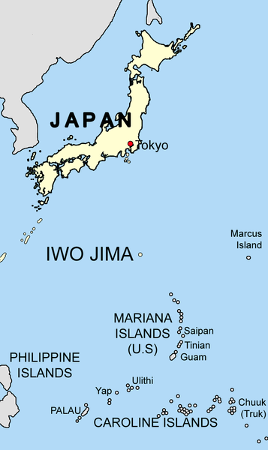
Though only eight square miles, the island sat between the Mariana Islands and mainland Japan. It served as an early-warning station for Japanese air defenses and a base for intercepting American bombers. Securing Iwo Jima would protect B-29 raids over Japan and provide emergency landing fields for damaged aircraft returning from bombing missions To weaken Japanese forces, American troops began with airstrikes.
American military intelligence believed that Iwo Jima would fall in a week.
Via Study.com
After months of naval and air bombardment, Marines enacted a land invasion of the island of Iwo Jima in a mission called “Operation Detachment”. Assigned to the command defending Iwo Jima, Lieutenant General Tadamichi Kuribayashi had other plans. Knowing that if the Americans fought by land, the Japanese would more than likely lose. He sought to cause as many American casualties as possible, in an attempt to dissuade the United States, Britain, and Australia from invading the Japanese home islands.
Typically, the Japanese would begin their line of defense at the beach. Though they did rain heavy weapons fire on the beaches, the heft of their defense was focused inland, specifically digging an extensive network of tunnels. This allowed soldiers to move freely and without detection. By the time of the American invasion 11 of the planned 17 miles of tunnels were dug. Along these tunnels were numerous sniper nests and camouflaged machine gun points. The Japanese also had bunkers 75 feet underground.
Areas were heavily mined. Despite having an extensive array of weapons at their disposal including mortars and rockets, the Japanese only had 60% of typical weaponry for an engagement of this scale. Additionally, they also only had enough food for four months.
Marines had to engage in vicious hand to hand combat. Particularly gruesome engagements included “the Meat Grinder” where 820 Marines were killed, or Japan’s last stand, “Bloody Gorge”. An estimated 70,000 American Marines and 18,000 Japanese soldiers took part in the battle. Nearly 7,000 Marines, a whopping 10% of those involved were killed. Another 20,000 were wounded. 216 were taken as prisoners of war. It was the only major Pacific battle in which American casualties exceeded those of the Japanese defenders.
The cost stunned the nation.
During Bloody Gorge, Marines turned to flamethrowers to smoke the Japanese out of their tunnels. The Japanese were equally ruthless, often yelling “corpsman!” pretending to be injured Marines in order to kill Navy personnel attached to infantry platoons. However, the Japanese ran out of fresh water, food, and most supplies by the time American reinforcements arrived. Though outnumbered, most fought to the death.
For military planners, Iwo Jima offered a sobering preview. If eight square miles could exact such a toll, what would invasion of the Japanese mainland require? The battle contributed to calculations that would ultimately shape the war’s end.
Iwo Jima reminds us that victory in World War II was not inevitable. It was earned — yard by yard, tunnel by tunnel — by young Americans who advanced under withering fire because retreat was not an option.
The island was small. The sacrifice was not.
Eighty years later, Iwo Jima remains a testament to what discipline, cohesion, and resolve can accomplish under impossible conditions. It stands as a reminder that freedom has often depended on ordinary citizens willing to endure extraordinary hardship.
For 36 days in 1945, that burden fell on the Marines who fought across volcanic rock and into history.